
 Porsche
The key point
The evaporator was not leaking when removed; the owner chose preventive replacement because of age. Necessary fault repair and that additional choice are distinct.
- Vehicle / subject
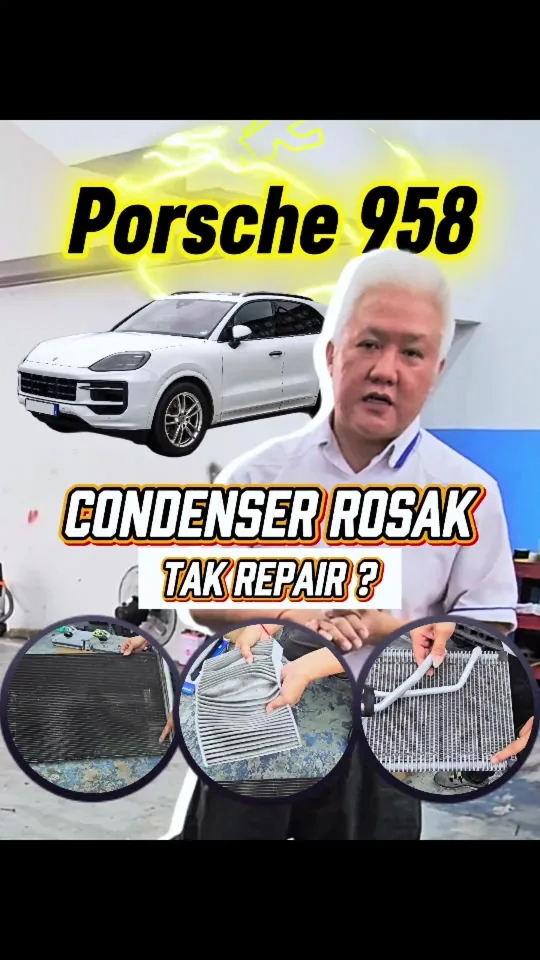
- Porsche Cayenne 958 (second generation)
- Record type
- A case from Sifu White’s workshop
- Original video
- 2025-12-31
Sifu White explains what happened
Prices, repair times and warranty terms mentioned in the video applied at the time. Ask the workshop about current arrangements.
Today we are discussing a second-generation Porsche Cayenne 958. Initially, the condenser leak was not easy to see. The owner had been told that there was no external leak and wanted Sifu White to inspect the cooling coil inside. When the car arrived, however, we immediately saw signs of a condenser leak.
The bumper must be removed for a clear inspection. Condenser replacement involves considerable work because the radiator, hose set and bumper have to be moved or removed for access. We also asked whether the customer wanted the dashboard opened to inspect the cooling coil at the same time. The car was old enough that the customer agreed. Inspection showed that the cooling coil was not yet leaking.
Although the cooling coil was not leaking, it was aged and the customer chose to replace it at the same time. We selected a unit matching the original specification. The cabin air filter was also extremely dirty and was replaced. The job requires dismantling components around the heater pipes and casing, along with complete dashboard removal.
Although this work involves many steps, it is manageable for us.
Why cooling after a regas does not prove a repair
Refrigerant circulates through a closed circuit; it is not fuel that the engine consumes. If cooling returns after charging and then deteriorates, the investigation should establish whether there is a leak, whether the previous charge matched the specification, and whether another control or heat-rejection problem is present. The initial return of cold air describes performance at that moment. It does not show that a leaking component has been repaired.
A model’s familiar failure pattern is a starting point, not proof. The condenser, connections, hoses, compressor seals and evaporator inside the cabin are different possible inspection locations. An oil stain can guide a leak test, but it is not a substitute for confirmation. Finding one leak also does not clear every other part of the circuit. After repair, the sealing and cooling performance need to be checked again under conditions relevant to the original complaint.
What to compare before repairing or replacing a part
A similar shape, a logo or a seller’s use of “original”, “OEM” or “recon” does not establish suitability on its own. Model, year, engine configuration, part number and connections need matching. Supply traceability, actual condition and warranty terms are separate checks. New components still need inspection before and after installation, while used components need particular attention to their history and the basis on which they have been tested.
The value of a component repair also depends on the assembly’s internal condition and the availability of suitable repair parts. An external clutch fault can require a different solution from internal wear or contamination. Compare labour, related system work, the possibility of having to dismantle the assembly again and written coverage as well as the part price. Prices, turnaround times and warranties mentioned in a historical video do not automatically apply to another vehicle.
What to tell the workshop about your own car
You do not need to guess a part name first. A clear description of what actually happens is often more useful for reproducing the complaint than requesting a particular replacement.
- Record the last regas date and how long cooling lasted.
- Bring earlier quotations, part numbers and warranty records.
- Include the model, year, recent repairs and what changed before or after the symptom began.
Questions owners ask
Should the air-cond need repeated regassing?
Repeated regassing should trigger an investigation rather than become the routine solution. Record how long cooling lasts after each visit and have the leak locations and charge specification checked.
Is buying a cheaper part and paying for fitting always cheaper?
Compare the total cost and who handles a problem. Incorrect fitment, a defective part or repeat dismantling can erase the price saving. Confirm compatibility, inspection and after-sales arrangements before buying.
Original video and further reading
Original video by Sifu White, recorded on 2025-12-31.
Watch the original on TikTok ↗HELLA · Automotive air-conditioning ↗Contact details and arrangements in older videos may have changed. Please use this page’s WhatsApp link.
 Proton
 BMW
BMW