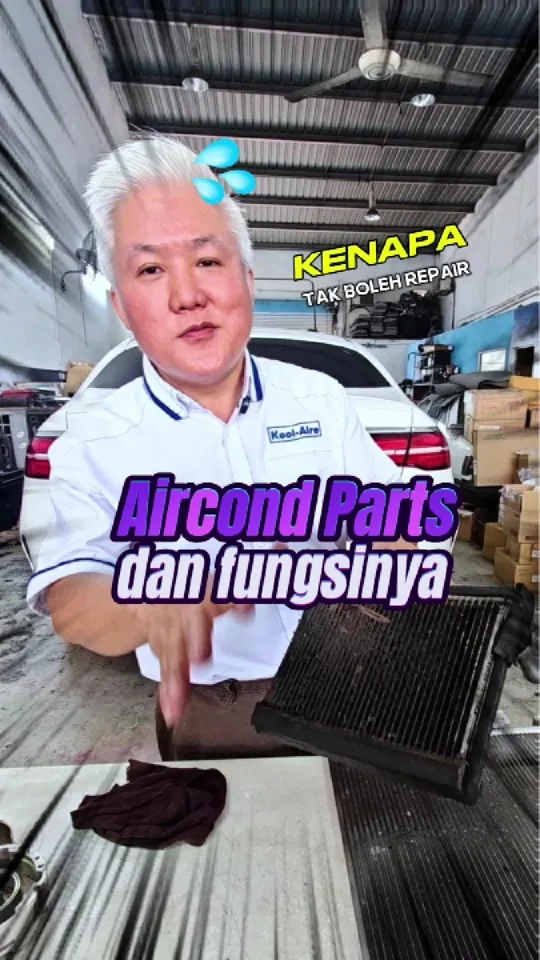
 Audi


The key point
Condenser passages and front-end access are discussed; contamination and cleanability, not access convenience alone, determine the repair scope.
- Vehicle / subject
- Audi TT
- Record type
- A case from Sifu White’s workshop
- Original video
- 2025-11-25
Sifu White explains what happened
Prices, repair times and warranty terms mentioned in the video applied at the time. Ask the workshop about current arrangements.
Today we are discussing the Audi TT. A common problem is compressor failure and lack of cooling. When the compressor fails, we recommend replacing the condenser as well. The black oil and debris show that contamination from the compressor has affected the next components in the system.
The condenser is one of the first components to receive contamination. Piping and some other parts may still be flushed and reused, but the condenser generally requires replacement because its internal passages cannot be fully cleaned. Replacing only the receiver drier is insufficient because contaminated refrigerant enters the condenser before reaching the drier. The condenser is already contaminated upstream. A suitable OEM condenser can be recommended.
Why can the condenser not be cleaned? Its internal passages are extremely thin and fine. A flushing machine cannot remove all contamination from channels that small. Flushing is primarily used to remove old oil and clean components whose passages can genuinely be cleared. Do not assume that flushing solves every air-conditioning problem.
Some foremen want to replace only the compressor. Replacing the condenser on an Audi TT involves more work and may require removing the bumper, radiator and intercooler. Despite the difficulty, contamination must be handled correctly for the repair to last.
How contamination changes the repair scope
Refrigerant and lubricant travel through several components. Debris from internal compressor wear can therefore create a problem beyond the compressor itself. Installing a replacement while contamination remains in circulation can expose the replacement to the same problem. The investigation should distinguish the source of damage, the spread of contamination and the condition of components that might still be serviceable. Neither “compressor only” nor “replace everything” is a complete diagnosis on its own.
Whether flushing is appropriate depends on component construction, contamination and the manufacturer’s procedure. Fine passages and trapped debris can be difficult to clean reliably. Compressors, driers and metering devices cannot simply be treated as open lengths of pipe during flushing. Oil colour is one observation, but colour alone does not measure moisture content or establish that every component has failed. An itemised explanation should identify what needs replacement, what can be cleaned, and the evidence behind each decision.
Why access and reassembly matter to the result
The evaporator usually sits inside the cabin HVAC housing. Access depends on the model, year and housing design. Some vehicles require dashboard removal; others provide a side-access route. Fewer dismantling steps are not automatically better, and more dismantling is not automatically necessary. What matters is whether the component can be reached correctly and whether clips, fasteners, wiring and seals can all be restored as intended.
Foam and duct seals keep air travelling through the intended paths. A damaged housing, missing fasteners or displaced seal can leave air leaks, noises or uneven delivery. The repair plan should therefore cover reassembly checks as well as the price of the replacement coil. Marks from earlier work may be useful clues, but glue or cracks alone do not establish who caused the damage or exactly how it happened.
What to tell the workshop about your own car
You do not need to guess a part name first. A clear description of what actually happens is often more useful for reproducing the complaint than requesting a particular replacement.
- Ask for an itemised scope separating contamination work from leak repair.
- Ask about access, seals, fasteners and the functions checked after reassembly.
- Include the model, year, recent repairs and what changed before or after the symptom began.
Questions owners ask
Does compressor failure require replacing the whole system?
Not automatically. Wear, contamination, leaks and the ability to clean a component determine the scope. A sound component is not defective merely because it belongs to the same circuit.
Must the dashboard always come out for a cooling coil?
It depends on the exact vehicle and housing design. Use a method that allows proper removal and complete reassembly rather than applying one model’s shortcut to every car.
Original video and further reading
Original video by Sifu White, recorded on 2025-11-25.
Watch the original on TikTok ↗HELLA · Automotive air-conditioning ↗HELLA · Flushing and contamination ↗Contact details and arrangements in older videos may have changed. Please use this page’s WhatsApp link.