 Honda
Honda

The key point
The examples explain speed matching, not universal interchangeability across Type R, M, Lancer or Evo variants.
- Vehicle / subject
- Honda Honda Civic Type R / BMW E46, M3, M5, 320, 325 / Mitsubishi Lancer, Evo
- Record type
- Air-conditioning explained by Sifu White
- Original video
- 2025-09-24
Sifu White explains what happened
Prices, repair times and warranty terms mentioned in the video applied at the time. Ask the workshop about current arrangements.
A Honda Civic Type R owner asks whether its cooling coil type or price differs from that of a regular model. Based on experience with imported and locally assembled cars, the Type R cooling coil is not necessarily different. Differences are more likely in the compressor, piping or condenser, while the cooling coil may be shared with a standard Civic.
BMW provides an example. We have long repaired models such as the M3 and M5, and Sifu himself drives an E46. An M3 and a non-M3 may share the same cooling coil, while the compressor can be larger depending on engine capacity. A performance car needs a compressor specification suited to its engine.
On models such as the BMW 320 and 325, the compressor depends on engine configuration; four-cylinder and six-cylinder versions are not necessarily the same. Pulley size can also differ. A Mitsubishi Lancer and Evo may use essentially the same compressor, while a larger or smaller pulley changes compressor speed.
On a performance car whose engine often operates at higher RPM, pulley sizing can control and reduce compressor speed to improve durability. On a normal car, the compressor may run faster to provide adequate everyday cooling. Even with a powerful engine, the compressor still has to operate within a suitable speed range.
Performance-car air-conditioning design also requires a suitable compressor. Cooling performance depends not only on the compressor but also on heat-rejection components such as the condenser and fans, especially when the engine produces more heat. The full explanation is too long for a single video.
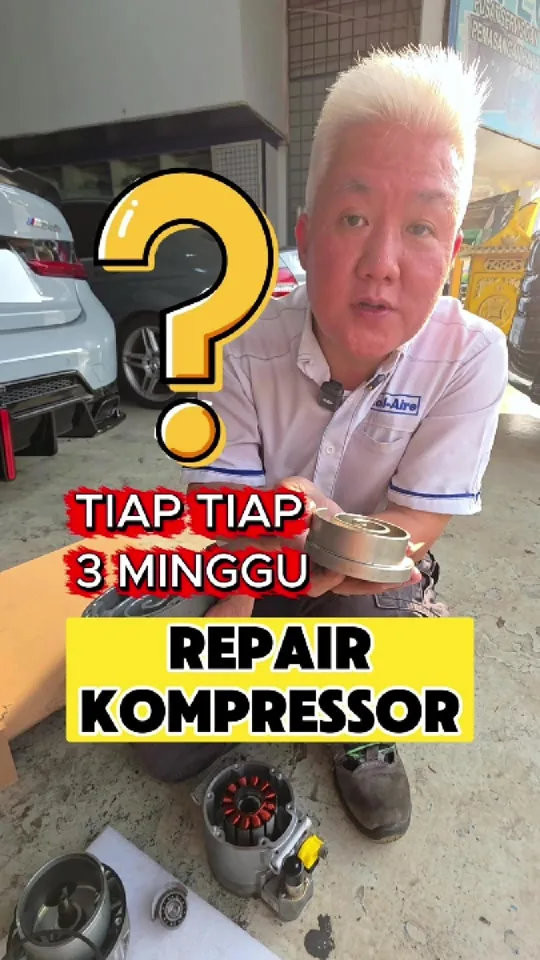
The compressor and its clutch are not the same component
Some belt-driven compressors use an electromagnetic clutch to engage the drive. Clutch, pulley or bearing faults can cause noise, friction or failure to transmit drive. Internal compressor damage is a separate assessment. A failed external component does not automatically condemn the compressor, but fitting a clutch will not restore worn internal pumping components either. The design also varies: not every compressor has the same clutch arrangement.
Before a clutch-only repair, the mounting area, housing and bearing fit need to remain suitable, alongside the condition of the compressor itself. After fitting, operation and any abnormal contact still need checking; a new part is not evidence that the job is complete. Where seizure, burning or belt damage is apparent, the cause should be investigated instead of repeatedly trying to force the drive to turn.
What to compare before repairing or replacing a part
A similar shape, a logo or a seller’s use of “original”, “OEM” or “recon” does not establish suitability on its own. Model, year, engine configuration, part number and connections need matching. Supply traceability, actual condition and warranty terms are separate checks. New components still need inspection before and after installation, while used components need particular attention to their history and the basis on which they have been tested.
The value of a component repair also depends on the assembly’s internal condition and the availability of suitable repair parts. An external clutch fault can require a different solution from internal wear or contamination. Compare labour, related system work, the possibility of having to dismantle the assembly again and written coverage as well as the part price. Prices, turnaround times and warranties mentioned in a historical video do not automatically apply to another vehicle.
What to tell the workshop about your own car
You do not need to guess a part name first. A clear description of what actually happens is often more useful for reproducing the complaint than requesting a particular replacement.
- Describe whether the noise starts before A/C engagement, after it, or with engine speed.
- Bring earlier quotations, part numbers and warranty records.
- Include the model, year, recent repairs and what changed before or after the symptom began.
Questions owners ask
Can just the magnetic clutch be replaced?
It can be considered where the design permits it and the compressor, housing and mounting surfaces pass inspection. Compare repair and assembly replacement after those checks.
Is buying a cheaper part and paying for fitting always cheaper?
Compare the total cost and who handles a problem. Incorrect fitment, a defective part or repeat dismantling can erase the price saving. Confirm compatibility, inspection and after-sales arrangements before buying.
Original video and further reading
Original video by Sifu White, recorded on 2025-09-24.
Watch the original on TikTok ↗HELLA · Automotive air-conditioning ↗Contact details and arrangements in older videos may have changed. Please use this page’s WhatsApp link.